
Satellite Mission Simulator
Simulate the mission before it becomes an operation
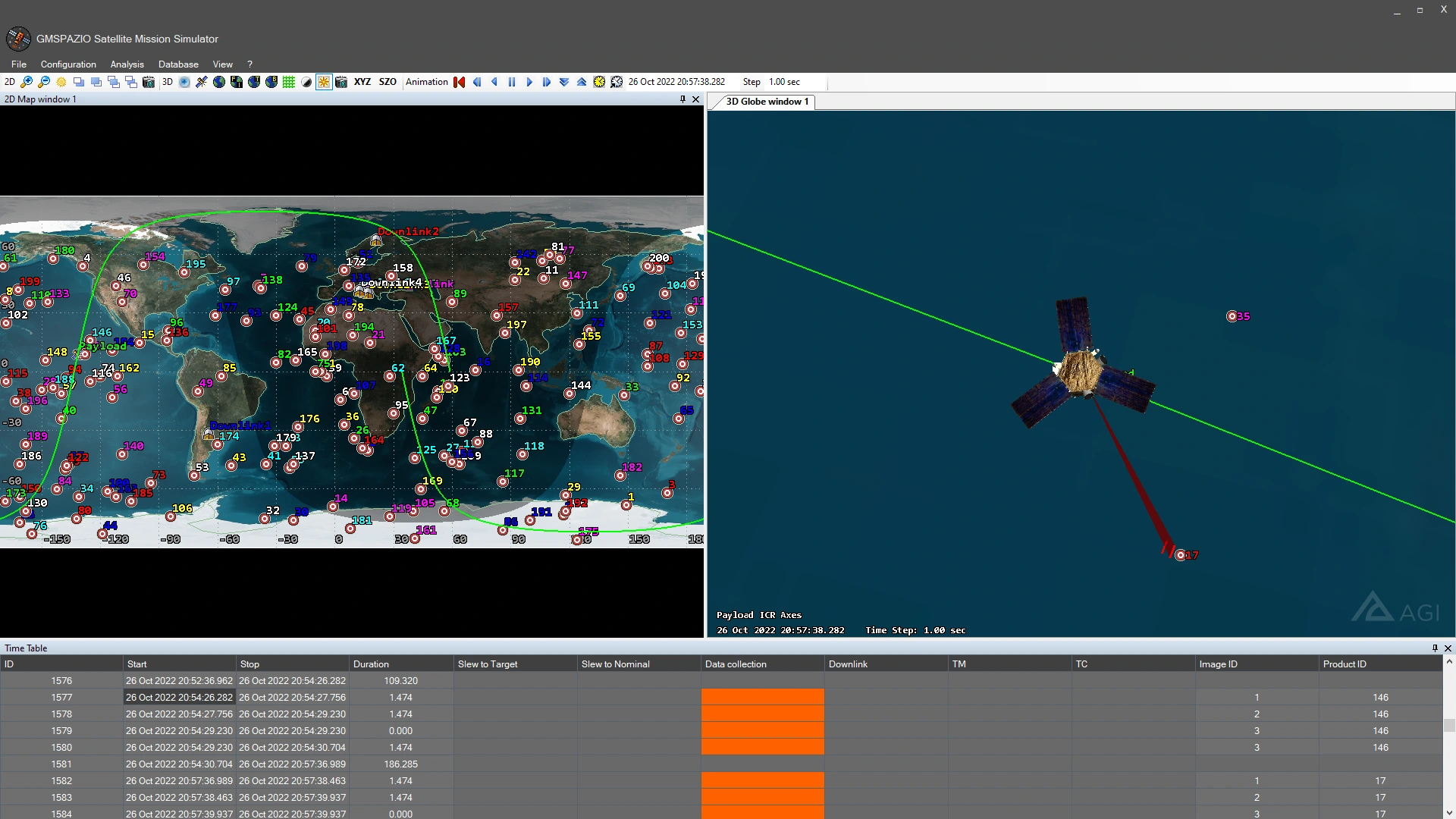
GSMS is the GMSPAZIO simulator designed to evaluate the behavior of a satellite system from a mission-level perspective.
It allows for the analysis of operational scenarios, system performance, real-world constraints, planned activities, and acquisition processes, using 2D and 3D environments to make the mission clearer, measurable, and comparable.
System Introduction
From satellite simulation to mission evaluation
A satellite mission does not depend on the orbit alone. The target, payload, acquisition window, user priorities, scheduling, downlink, ground stations, operational constraints, and the time required to transform a task into available data all matter.
GSMS was created to interpret these elements together. The tool allows for the simulation of the entire satellite system behavior, evaluation of mission performance, and comparison of different scenarios before operational deployment.
Mission types
More realistic operational scenarios
GSMS supports two main analysis modes: System Performance Analysis and Planner-Scheduler Analysis.
The first measures the overall performance of the satellite without user constraints. The second evaluates the mission under conditions closer to operational reality, including priorities, task scheduling, multiple requests, and usage quotas.
<p>Measures the global performance of the satellite system within a mission scenario.</p>
</p>
<p>
Assets and payloads
Configurable missions, targets, and constraints
GSMS allows for the configuration of satellite scenarios with different targets, areas of interest, and operational constraints.
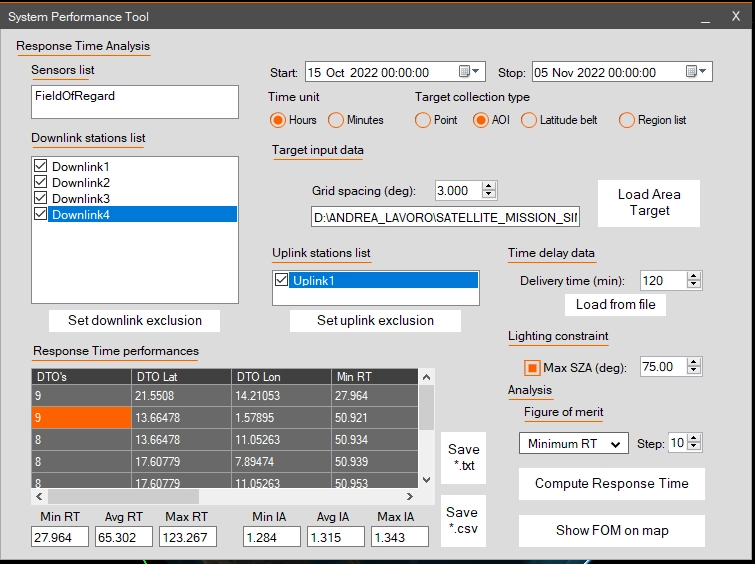
The tool supports point targets, AOIs, latitude belts, and region lists, allowing the mission to be evaluated against specific objectives.
Analysis can include constraints such as Solar Zenith Angle, time delay, system operating modes, data rates, and selected ground stations.
Outputs and metrics
Understanding how the mission actually performs
GSMS transforms simulation into useful metrics for operational evaluation.
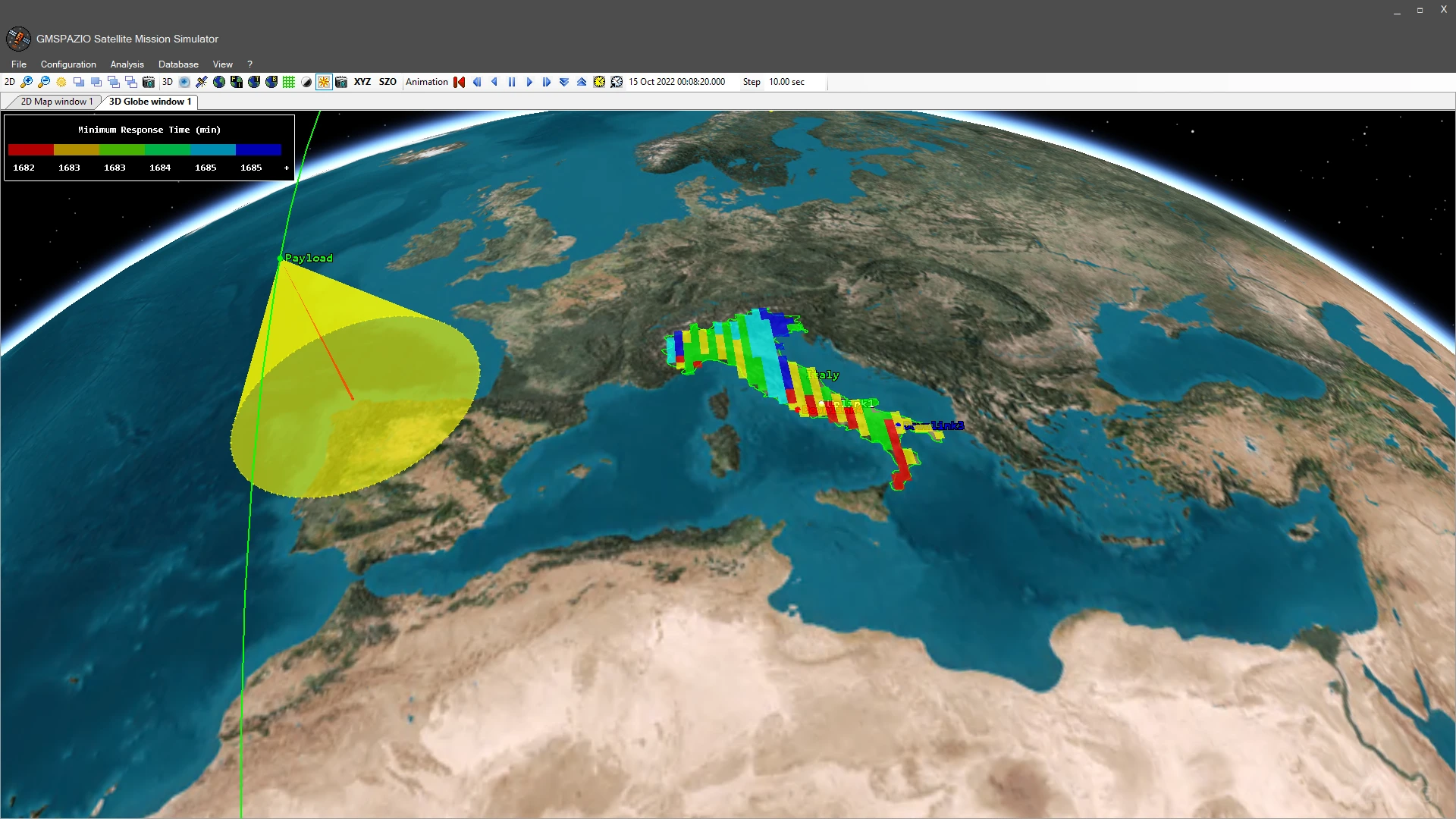
The tool measures response times, revisit time, and information age, helping to understand how effective a mission is relative to the required objectives.
<p>Measures the time between the task request and the image acquisition.</p>
</p>
<p>
Integrations
2D and 3D environment to interpret the mission
GSMS is built on the AGI STK platform and customized by GMSPAZIO to offer an immersive mission-level simulation environment.
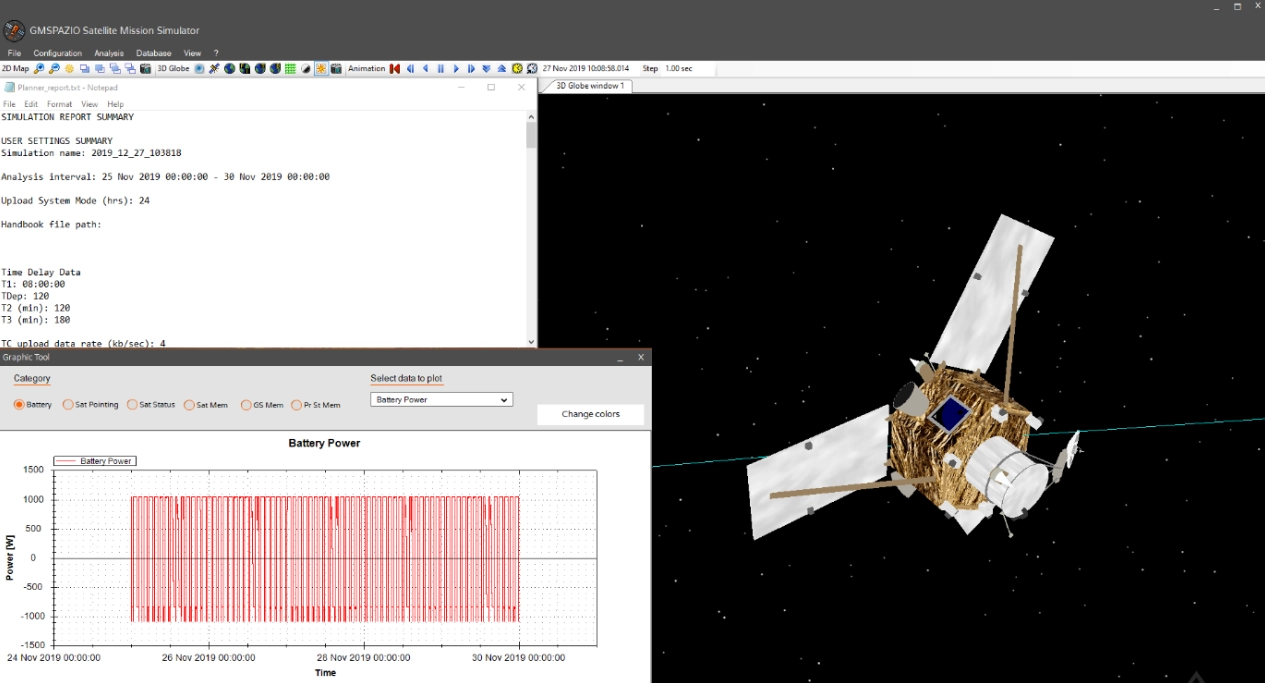
Scheduled activities can be viewed in 2D and 3D graphical modes, while results can be exported via comprehensive text reports.
The value is not just in seeing the mission. It is in understanding how performance changes when targets, constraints, priorities, ground stations, or time windows change.
Training
Training for satellite mission analysis
GSMS can be supported by dedicated training paths for technical teams, analysts, and operators.
Training helps in building scenarios, configuring targets, interpreting metrics, reading outputs, and using the simulator for mission-level evaluations.
Basic Training
Introduction to GSMS, scenario configuration, targets, constraints, and interpretation of main outputs.
Advanced Training
In-depth look at response time, revisit time, information age, planner-scheduler analysis, and multiple request management.
Custom Training
Paths built on real customer scenarios, focusing on missions, targets, ground stations, operational workflows, and specific requirements.

Request an operational demo
Transform the satellite mission into a measurable scenario.
