
System Introduction
Modeling and Simulation of the Underwater Acoustic Channel
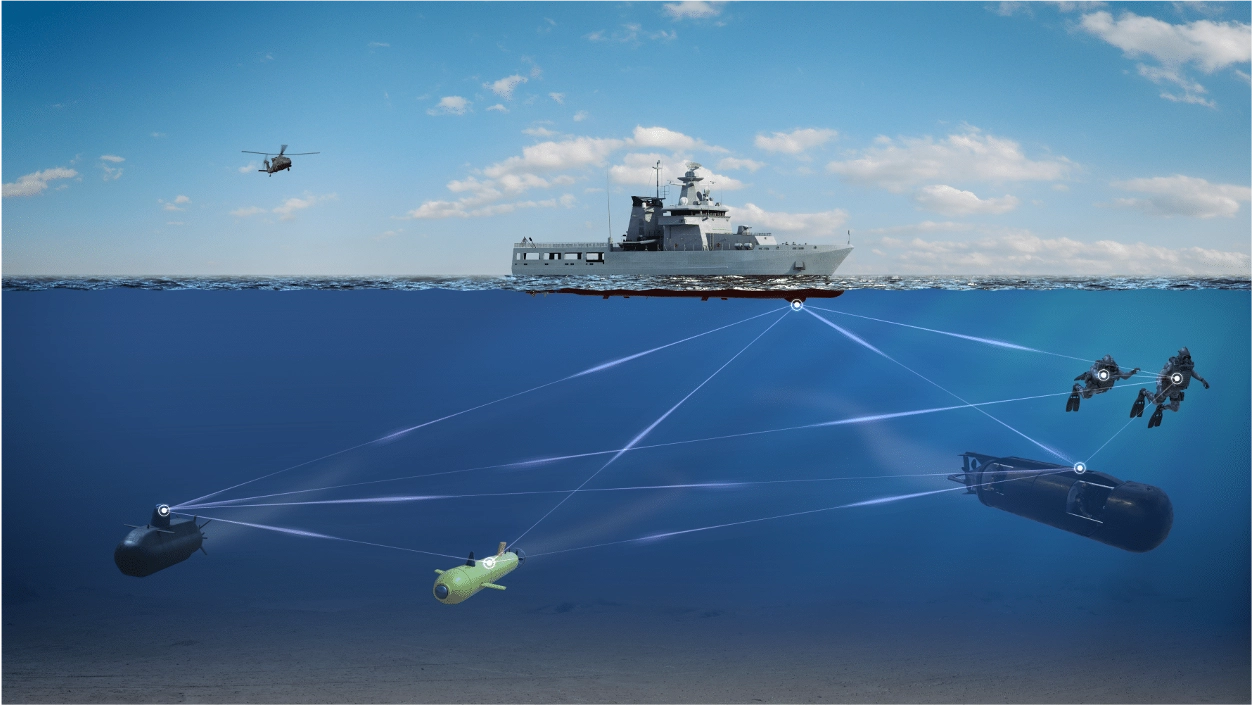
BlueComm is the Underwater Acoustic Engine developed by GMSPAZIO to model and simulate underwater acoustic communications and analyze signal behavior within realistic operational scenarios.
The system combines environmental data, seabed characteristics, water column profiles, platform locations, and transmission and reception parameters to reconstruct the behavior of the acoustic channel.
Using a ray-tracing-based approach, BlueComm allows you to evaluate propagation, attenuation, reflections, multipath effects, and link quality before actual deployment.
The simulated environment thus becomes a Digital Twin of the underwater domain, in which different configurations can be compared, critical issues can be identified, and the expected performance of systems and sensors can be verified.
What It Solves
From Sea Trials to Numerical Analysis
The performance of underwater communication depends heavily on the environment.
Depth, temperature, salinity, speed of sound, seabed characteristics, noise, platform locations, and the frequency used all affect signal propagation and connection quality.
Recreating all of these conditions through sea trials requires time and resources, and it is difficult to replicate these conditions exactly in subsequent trials.
BlueComm allows you to perform these assessments in advance through simulation.
Users can quickly modify the environment, network geometry, asset locations, and sensor configurations to compare alternative scenarios, verify the robustness of the connection, and identify the system’s operational limits.
The simulation thus supports design, testing, mission planning, and performance evaluation, reducing the number of field tests required.
How It Integrates
Environment, platforms, and sensors in a single scenario
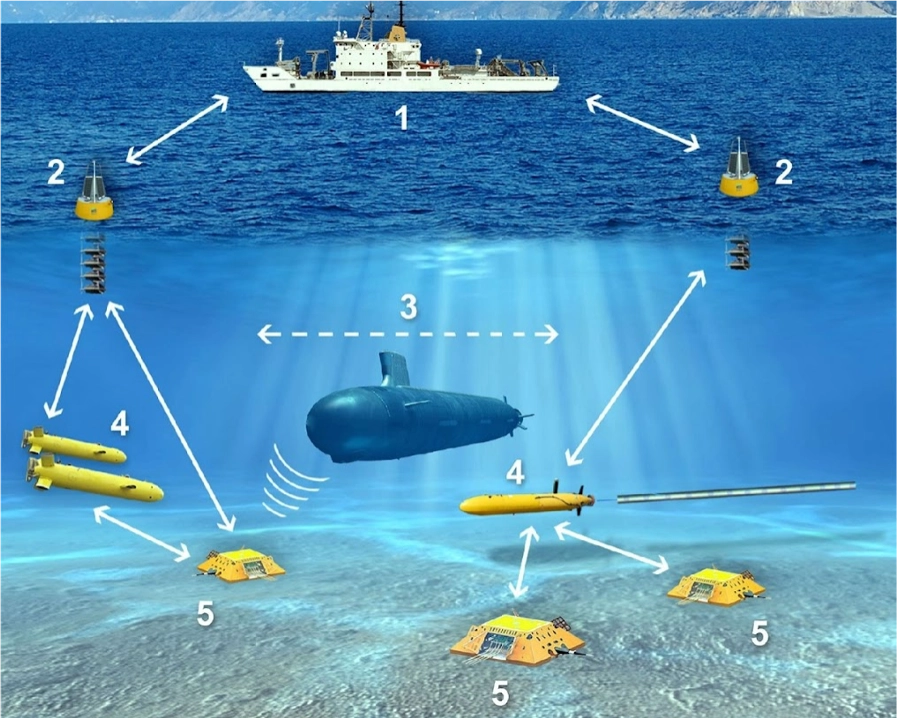
BlueComm guides users from the initial setup of the environment through to the final performance evaluation.
The model takes into account the sound velocity profile, temperature, salinity, depth, and bathymetry, with predefined profiles for different oceanic regions and the option to import custom profiles.
Transmitters and receivers are configured using parameters such as position, depth, power, frequency, bandwidth, beam angle, sensitivity, and noise level.
BlueComm also interfaces with STK scenarios to capture time-tagged positions of the platforms and analyze performance trends during the mission.
This makes it possible to link acoustic analysis to the actual dynamics of assets and integrate it into broader, multi-domain operational scenarios.
Output
Acoustic Data Transformed into Operational Results
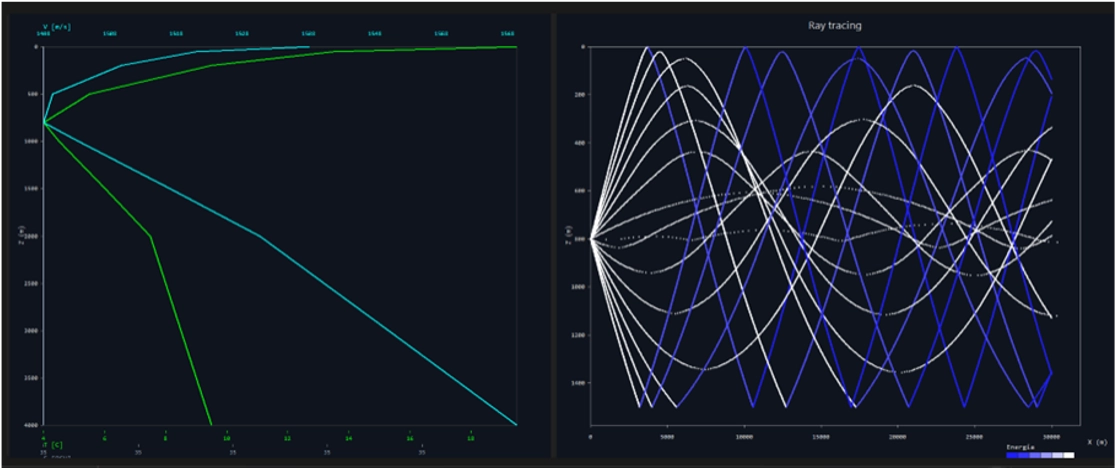
BlueComm generates numerical and graphical outputs designed to provide an immediate understanding of the underwater channel’s behavior. Key results include the sound velocity profile and a representation of the water column, the bathymetry of the area, the ray paths between the transmitter and receiver, and the power delay profile for analyzing multipath effects.
The platform also allows users to analyze the distribution of the angles of arrival, the channel transfer function, and the SNR as a function of frequency, in addition to providing a complete link budget that includes transmission loss, received level, and noise level. The output is rounded out by Eb/N0 values and an estimate of the bit error rate.
The results are compiled into charts, reports, and exportable formats so they can be used for technical studies, comparisons between configurations, documentation, and further analysis.
Sonar Analysis
From the acoustic channel to sensor evaluation
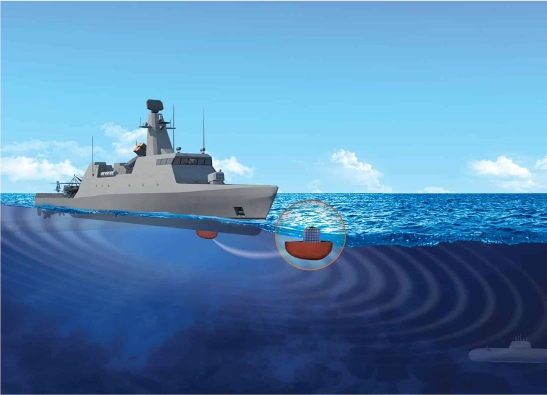
The BlueComm architecture extends acoustic environment modeling to include sonar performance analysis.
The simulation allows users to correlate environmental characteristics, propagation, distance, depth, and noise with the system’s response, supporting a quantitative assessment of performance within the scenario.
For monostatic sonar scenarios, the analysis includes parameters such as received echo level, SNR, and transmission loss, with a representation of performance as distance varies.
Training
Technical Training for Engineers and Operators
GMSPAZIO supports BlueComm with training activities focused on scenario development, underwater environment configuration, sensor setup, and result interpretation.
The course enables technicians and operators to understand how environmental parameters affect sound propagation and to use simulation to compare configurations, verify performance, and support operational planning.

Request an operational demo
Assess your underwater conditions before your test dive.
