
Advanced Radar Analysis
Understand what a radar sees first. And what it risks not seeing.
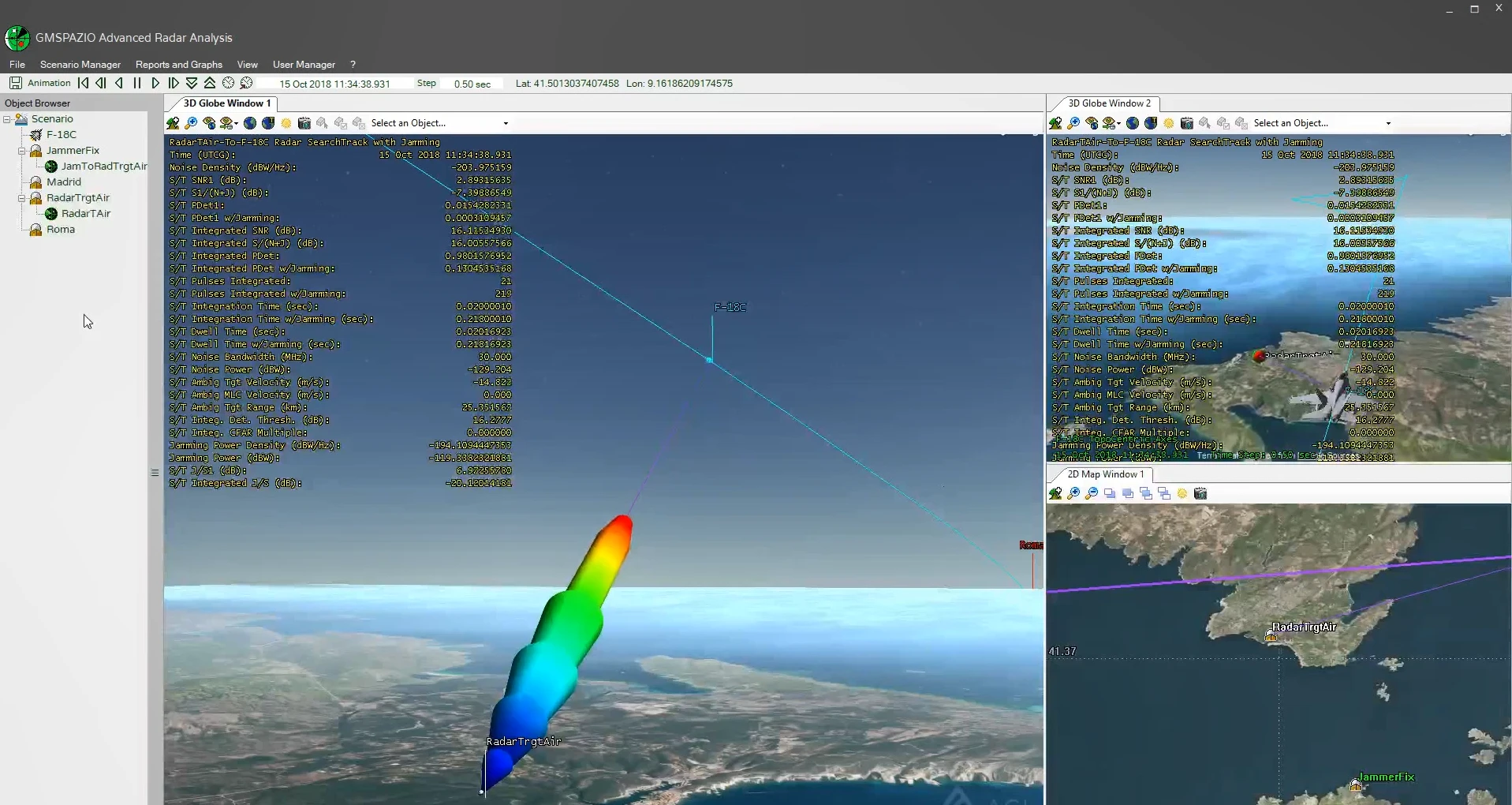
GARA is GMSPAZIO’s solution for simulating radar scenarios, evaluating sensor performance, and analyzing the probability of target detection in complex operational environments.
It integrates Ansys STK’s mission-level capabilities with tools developed by GMSPAZIO to configure missions, model radars, characterize targets, evaluate interference, and generate clear outputs for analysis and decision support.
System Introduction
Radar Analysis and Mission Planning
In an operational scenario, the ability to detect a target does not depend solely on the radar. It also depends on the sensor’s position, the target’s trajectory, the terrain, the atmospheric environment, distance, Radar Cross Section, the presence of jammers, and mission conditions.
GARA is designed to interpret these factors together, building simulated scenarios in 2D and 3D environments and transforming radar complexity into measurable information.
The result is a useful tool for evaluating coverage, performance, probability of detection, operational limits, and alternative configurations before actual deployment.
Use cases
From Detection to Information Superiority
GARA supports technical teams, operators, and analysts in evaluating scenarios where radar capability is crucial.
The platform helps understand where the radar sees best, where critical zones emerge, how detection changes with route variations, which conditions reduce performance, and which configuration offers the best operational result.
<p>Evaluation of radar capability to identify and track aerial targets in realistic scenarios.</p>
</p>
<p>
Sensor Configuration
Radar, Target, and Environment Setup
GARA allows configuring the main elements of the scenario: radar, aerial platforms, targets, missions, environment, and terrain data.
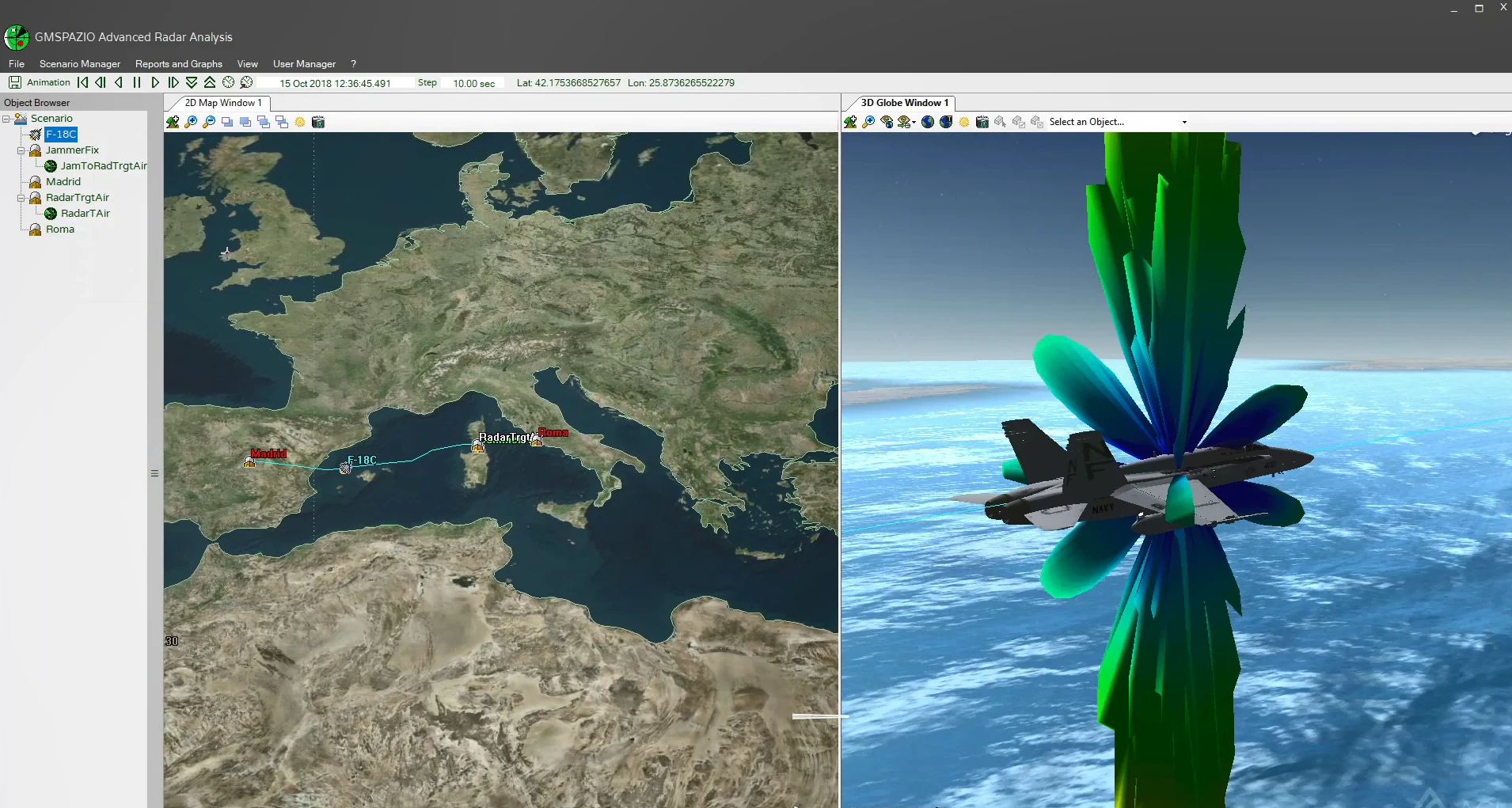
The user can define missions from waypoints, ephemeris, or attitude files, upload 3D models, set radar characteristics, and associate a specific Radar Cross Section with the target.
The simulation takes into account factors affecting radar performance, such as signal attenuation, atmospheric absorption, rain, clouds, fog, terrain scattering, radar specifications, jammers, and target RCS.
Analysis and Output
Radar Performance Made Readable
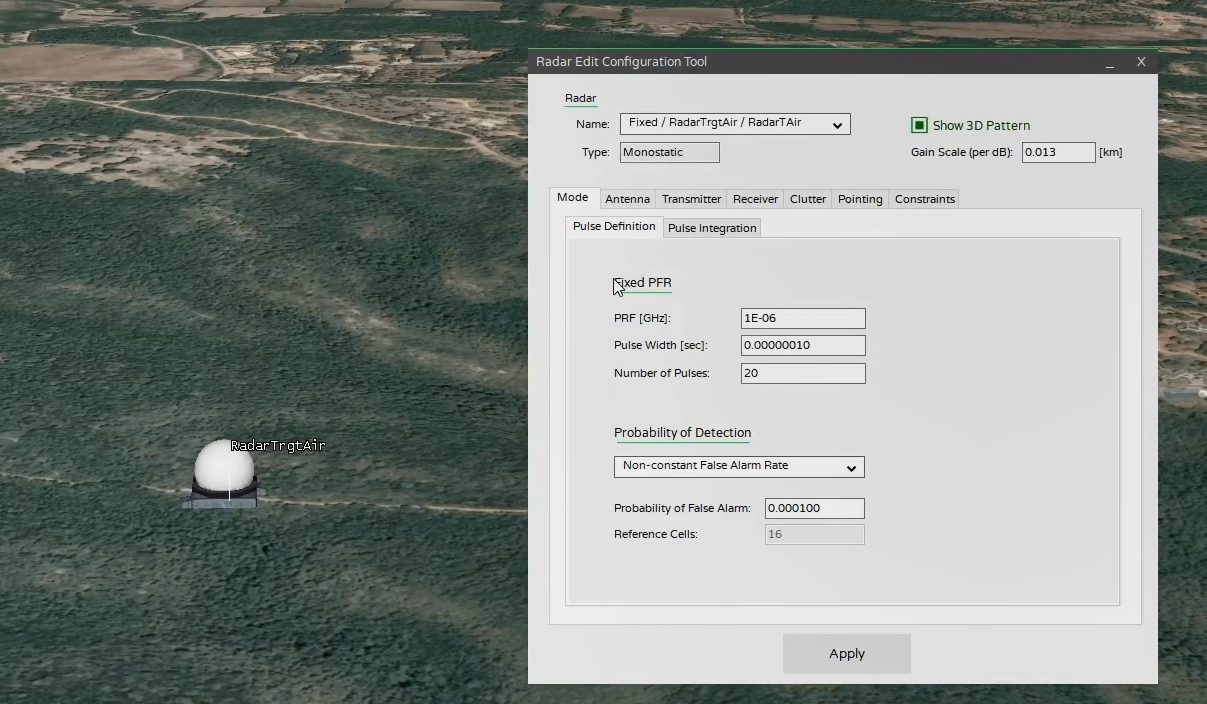
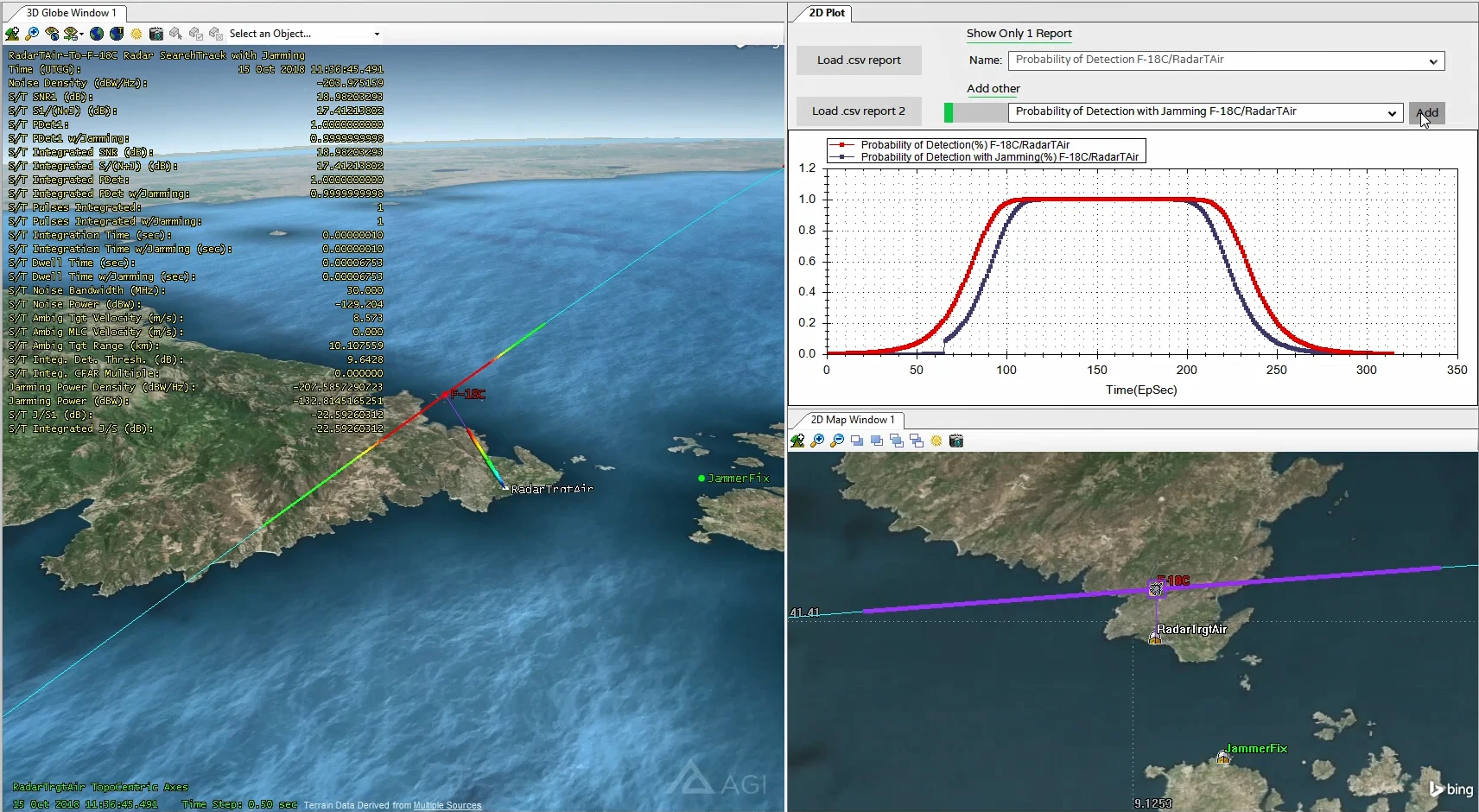
GARA transforms simulations into reports, graphs, and dynamic visualizations. The outputs help measure radar performance over time, evaluate detection probability, analyze jamming effects, and interpret the relationship between target, sensor, and environment.
The platform generates exportable reports and allows visualizing values in the 3D graphic window during scenario animation.
Main Outputs
Among the main outputs, GARA provides information related to the Radar Antenna, such as coordinates, azimuth, elevation, and gain, and the Radar Environment, including attenuation due to free space, atmosphere, rain, clouds, and fog.
The platform also allows analyzing Radar Geometry, through parameters such as range, range rate, azimuth, and elevation, and evaluating the target’s Radar Cross Section (RCS). For Radar Search-Track functions, it provides metrics such as SNR, probability of detection even in the presence of jamming, integration time, dwell time, noise power, and jamming power.
Integrations
Mission-Level Simulation and Operational Workflows
GARA integrates radar simulation with a mission-level environment, thus connecting sensors, targets, trajectories, terrain, and environmental parameters into a single scenario.
The GUI combines 2D and 3D views, allowing complex simulations to be configured, results visualized, and the evolution of radar parameters monitored over time.
GARA is not just reporting software. It is an analysis environment for understanding how a radar configuration performs within an operational scenario.
The platform supports the import of aircraft, ground stations, and radars, the loading of terrain imagery, and the dynamic visualization of results. It also allows for parametric analyses, comparison of different operational conditions, and export of reports and graphs useful for scenario evaluation.
Training
Training for Radar Analysis and Mission-Level Scenarios
GARA can be complemented by dedicated training courses for technical teams, analysts, and operators.
The training helps build scenarios, configure radars and targets, interpret reports, read graphs, and evaluate detection performance more autonomously.
Basic Training
Introduction to GARA, configuration of radar scenarios, setup of targets and sensors, interpretation of main outputs.
Advanced Training
In-depth study of RCS, jamming, probability of detection, Search-Track reports, atmospheric environment, and parametric analysis.
Custom Training
Courses built on real customer scenarios, focusing on specific sensors, targets, missions, workflows, and operational requirements.
Request an operational demo
Transforms complex radar scenarios into clear operational information.
